
There is a particular kind of grief that only pet owners understand — the kind that ambushes you at 6 a.m. when you reach for a leash that’s no longer needed, or when you hear a sound in the hallway, and your heart lifts for just a second before remembering.
A pet memorial tattoo won’t stop those moments. But for many people, it does something else: it makes the love permanent. It gives grief a shape, a place to live on your body, something you can look at on the hard days and feel like they’re still with you somehow.
This guide covers everything — design styles, placement options, finding the right artist, what to expect from the process, and how to make sure the tattoo you get truly honors the animal you lost. Whether you’re still in the early fog of loss or you’ve been thinking about this for two years and finally feel ready, you’re in the right place.
What Is a Pet Memorial Tattoo?
A pet memorial tattoo is any tattoo created specifically to honor a pet who has died. It might be:
- A realistic portrait of their face
- Their actual paw print (taken before or after death)
- Their name, in a font that feels like them
- A symbol — a small heart, a paw, a hummingbird — that captures something about who they were
- A scene from a memory: them sleeping in the sun, their favorite spot, the view from your morning walks together
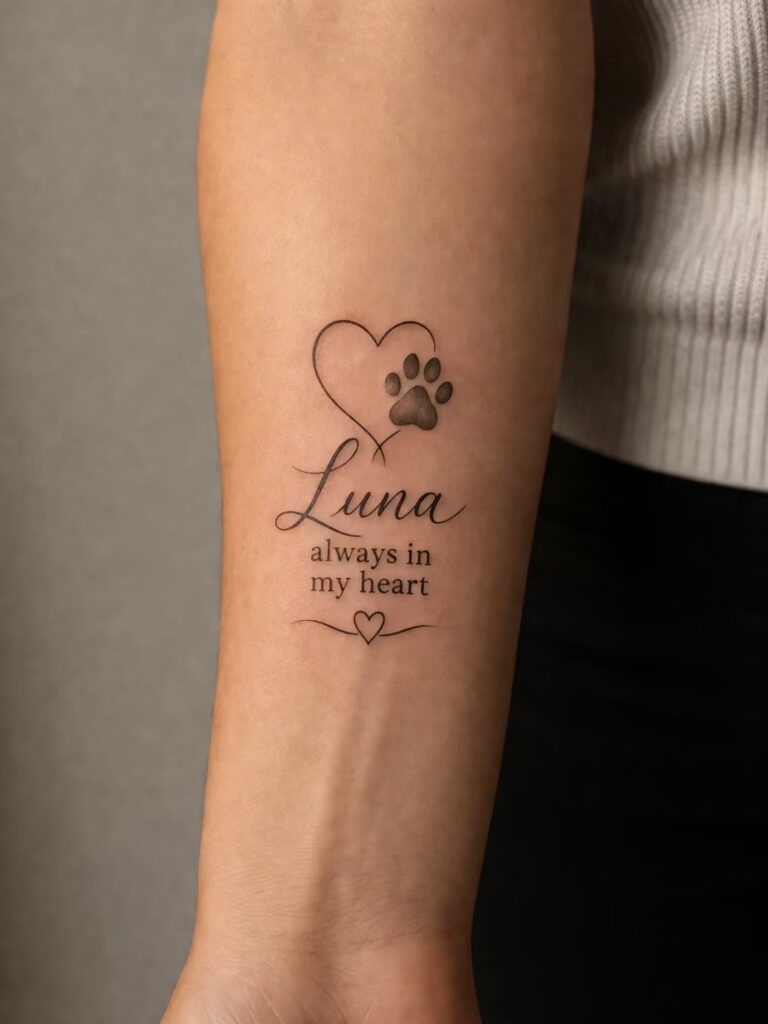
What separates a memorial tattoo from a general “pet tattoo” is intentionality. You’re not just showing you love dogs. You’re marking a specific animal, a specific bond, a specific loss. That distinction matters — both for the emotional weight of the piece and for the design choices you’ll make.
Why People Get Pet Memorial Tattoos
Grief researchers have a term for pet loss: disenfranchised grief — loss that society doesn’t fully recognize as legitimate. Many people who have lost a dog or cat have experienced this firsthand: the coworker who says “it was just a dog,” the family member who suggests getting a new one immediately, the feeling that you’re supposed to be over it by now.
A memorial tattoo is, in part, a refusal of that minimization. It says: ” This mattered. This relationship was real. I am allowed to carry this.
Beyond the symbolic, many people describe practical comfort: something to touch when the grief spikes, a conversation starter that lets them talk to strangers about their pet, a way of feeling like the animal is still with them in some form.
There’s no right reason to get one. If you’re considering it, that’s reason enough.
Popular Pet Memorial Tattoo Designs
1. Realistic Pet Portrait Tattoos
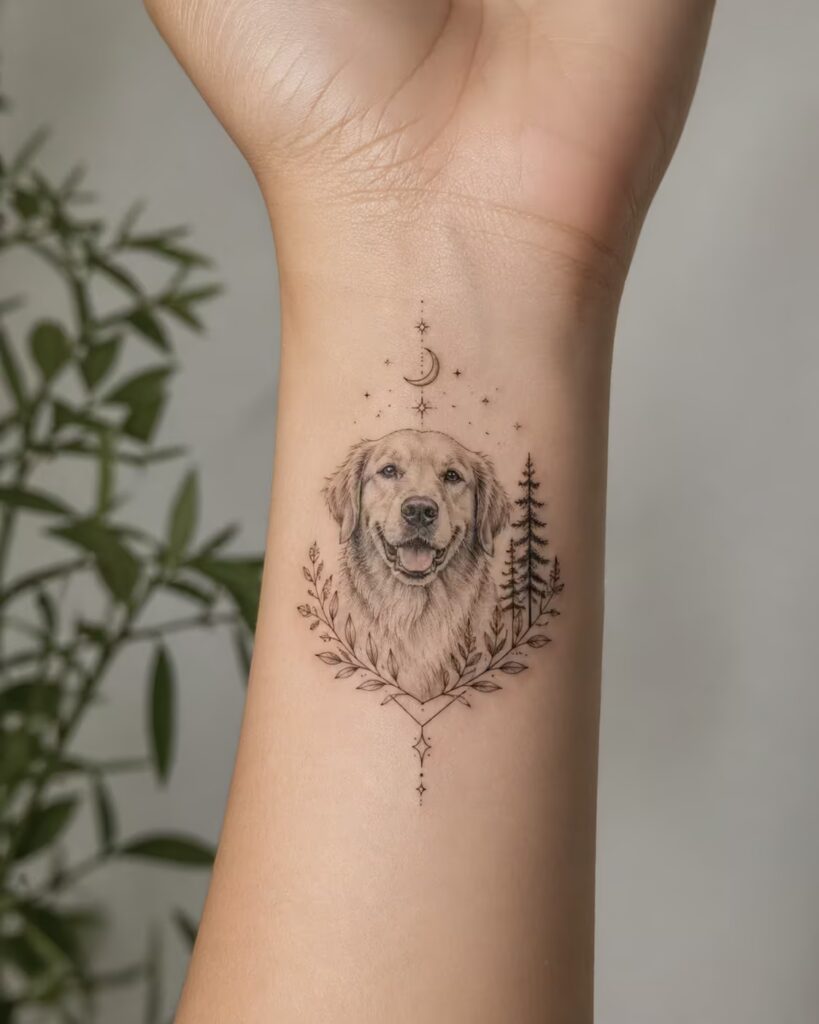
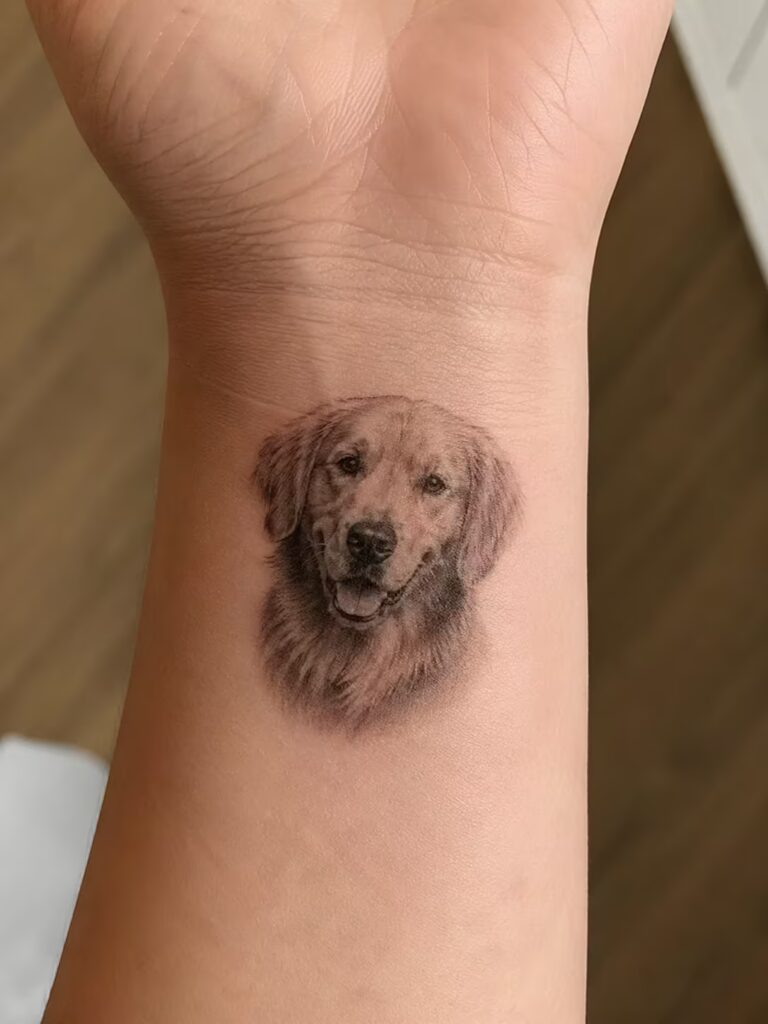
The most emotionally powerful option — and the most technically demanding. A skilled portrait artist can capture your pet’s exact face: the particular set of their ears, the markings around their eyes, and the way they looked at you.
What makes them work: Reference photos are everything. The artist needs high-resolution, well-lit images — ideally multiple angles. A blurry phone photo from across the room will produce a generic dog face, not your dog’s face.
Style variations:
- Black and grey realism (the most common — ages beautifully)
- Color realism (stunning when done well, requires exceptional skill)
- Painterly/illustrative (slightly softer than strict realism, more forgiving on smaller placements)
Best placement: Upper arm, thigh, wrist, calf, back, chest — anywhere with enough surface area for detail work.
Artist tip: For portrait tattoos, artist selection matters more than almost any other style. Look at their portfolio specifically for animal portraits. A great floral artist is not automatically a great portrait artist.
2. Paw Print Tattoos
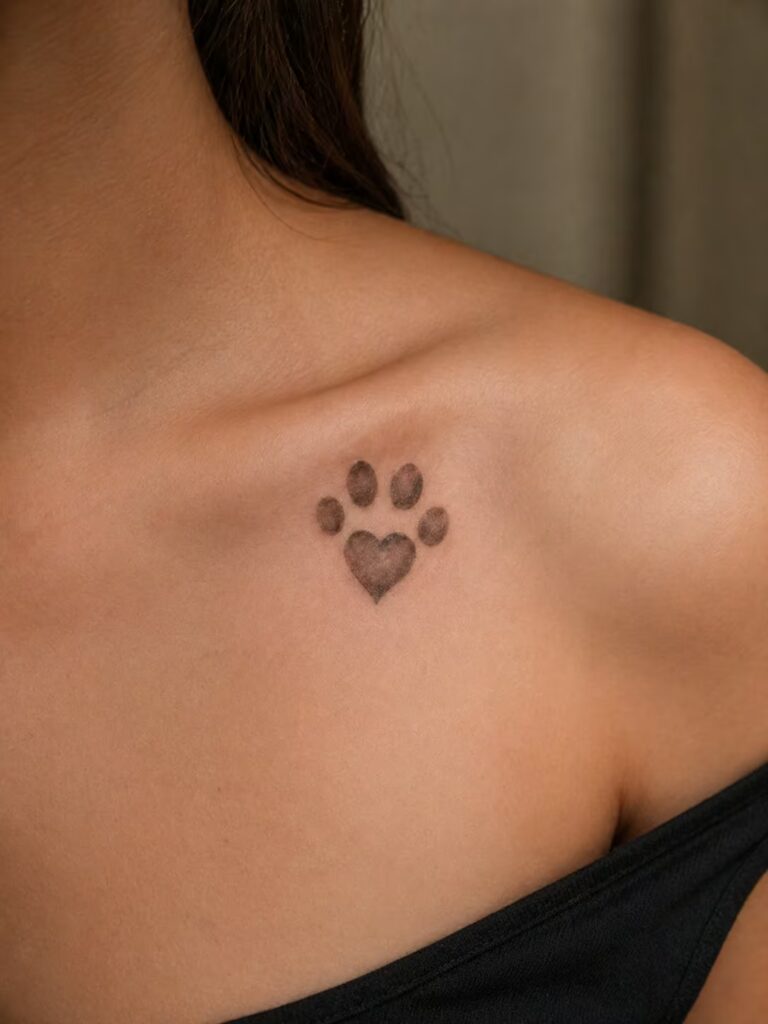
One of the most common memorial choices — and when done thoughtfully, one of the most meaningful. The power of a paw print tattoo is specificity: ideally, it’s their actual paw print, not a generic clipart shape.
Getting your pet’s actual paw print:
- Many veterinary clinics will take an ink or clay impression at the time of euthanasia, or you can request it
- Pet cremation services often offer paw prints as part of their service
- You can take a DIY ink impression at home while they’re still with you — something worth doing before you need it
- The print can then be photographed and sent to your tattoo artist as a reference
Style variations:
- Outline only (minimal, clean)
- Filled/solid
- Watercolor wash behind the print
- Heart incorporated into the print
- Name or dates incorporated below
Best placement: Wrist, inner forearm, ankle, collarbone, behind the ear (small versions), shoulder blade
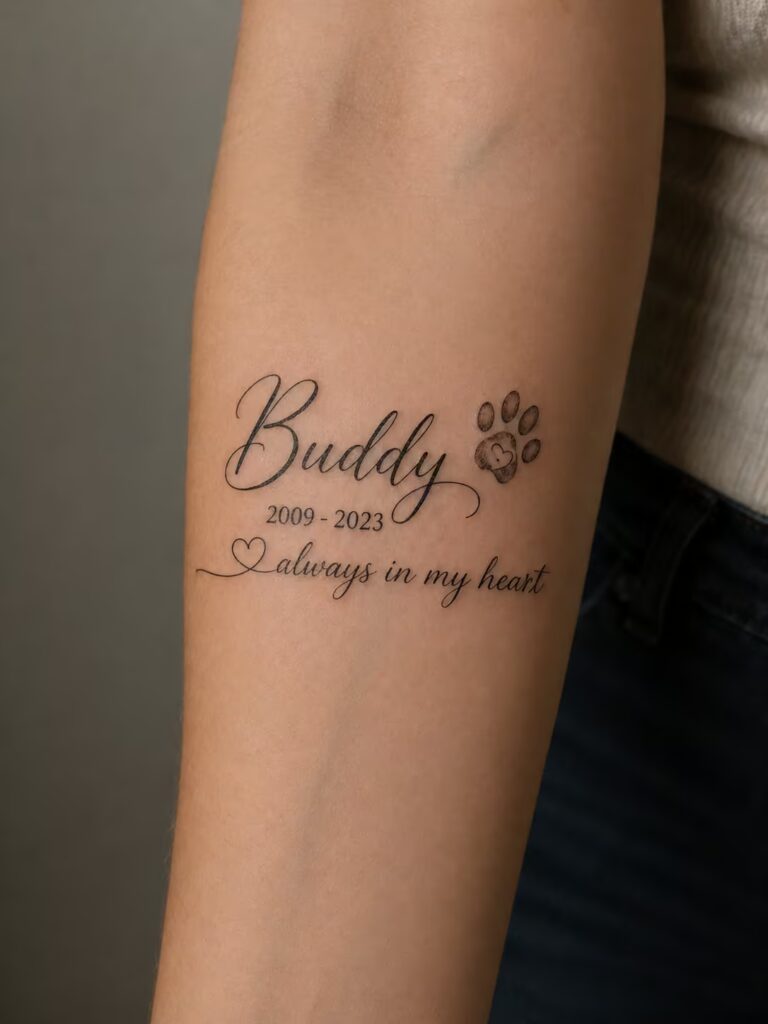
3. Name Tattoos
Simple, readable, permanent. A pet’s name in a script or font that suits them.
Making it feel intentional:
- Consider the font carefully — flowing script for a gentle soul, something bolder for a big personality
- Adding a small element (a single paw print, a tiny hummingbird, a heart outline) gives it visual weight without complexity
- Dates (date of birth and death, or just the years) add context and formality
- Some people add a short phrase, such as “Good boy.” “Always.” “My heart.”
Best placement: Inner wrist, forearm, ankle, collarbone, ribcage
4. Minimalist and Small Pet Memorial Tattoos
Not every memorial needs to be large or detailed. Small, minimalist tattoos can carry enormous meaning — sometimes more, because every element earns its place.
Popular minimalist approaches:
- A single continuous-line drawing of your pet’s silhouette
- A tiny paw print (stamp-sized)
- A small heart with their initial inside
- A simple animal silhouette in black
- Coordinates of a meaningful location (where you adopted them, your home address)
- A single word in a delicate font
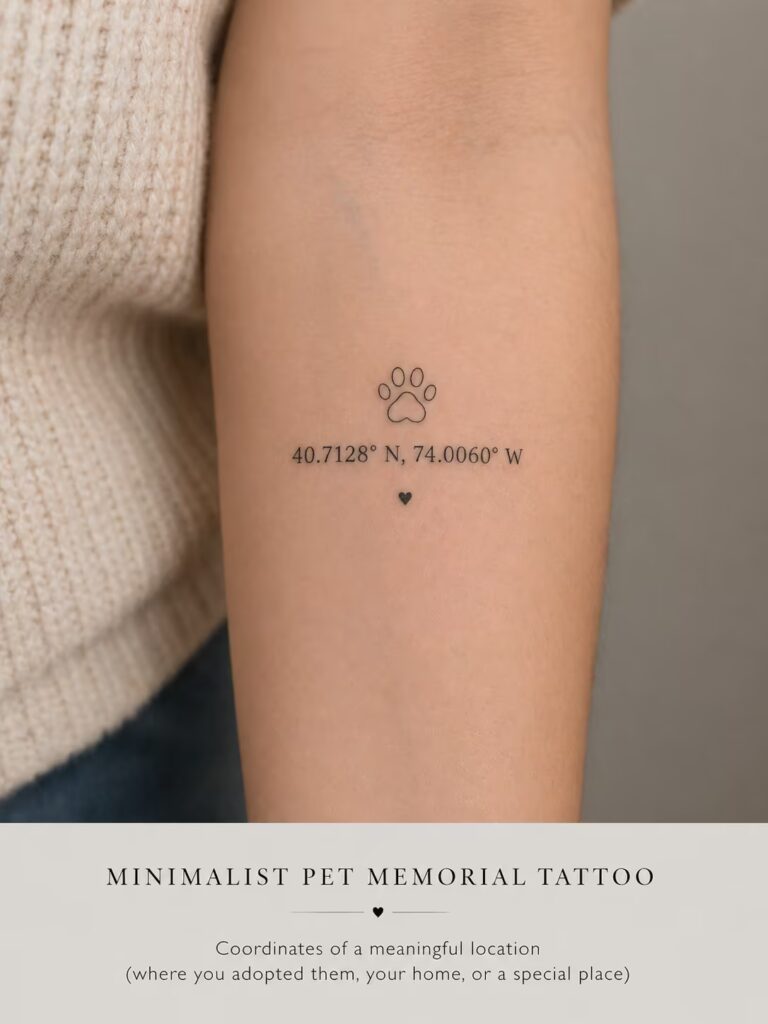
Artist tip: Small tattoos require a different skill set than large ones. Lines that are too fine will spread and blur over time. Find an artist who specializes in fine-line or micro tattoo work — not just someone willing to scale down their usual style.
5. Watercolor Pet Tattoos
Watercolor tattoos mimic the look of a loose watercolor painting — soft edges, color blooms, no hard outlines (or very minimal ones). They’re striking, feminine, and increasingly popular for pet memorials because they feel emotional and artistic rather than graphic.
What to know before committing:
- Watercolor tattoos fade faster than traditional styles because they lack the anchoring black outlines that hold pigment
- A skilled artist will incorporate subtle black work into the structure to help it age better
- Color selection matters: watercolor tattoos in blues, purples, and pinks often age better than yellows and light oranges
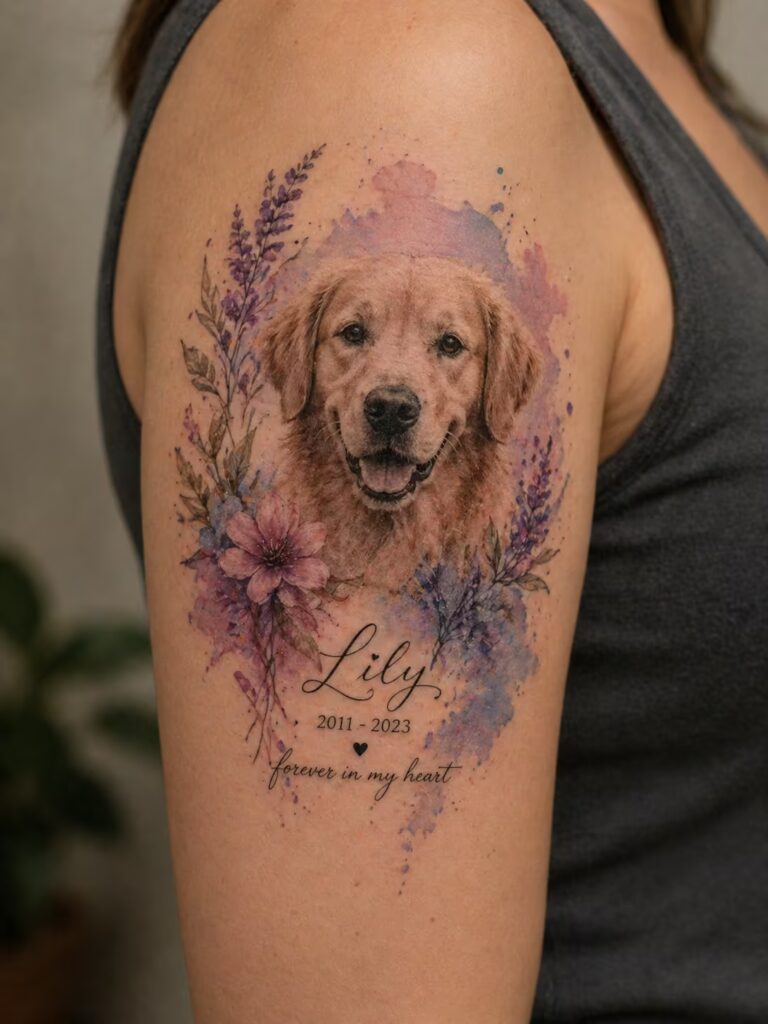
Best for: Floral elements around a portrait, abstract color splashes behind a silhouette, paw prints with soft color blooms
6. Pet Portrait Tattoos Combined With Nature or Symbols
Some of the most beautiful memorial tattoos layer the pet’s image or silhouette with natural elements that carry additional meaning:
- Wildflowers — especially the pet’s “birth month” flower
- Stars or constellations — the idea of them living somewhere above
- Mountains or landscapes — for adventurous dogs and outdoor life together
- The moon — quiet, soft, luminous
- A window with light — one of the most quietly devastating and beautiful compositions in memorial tattoo art
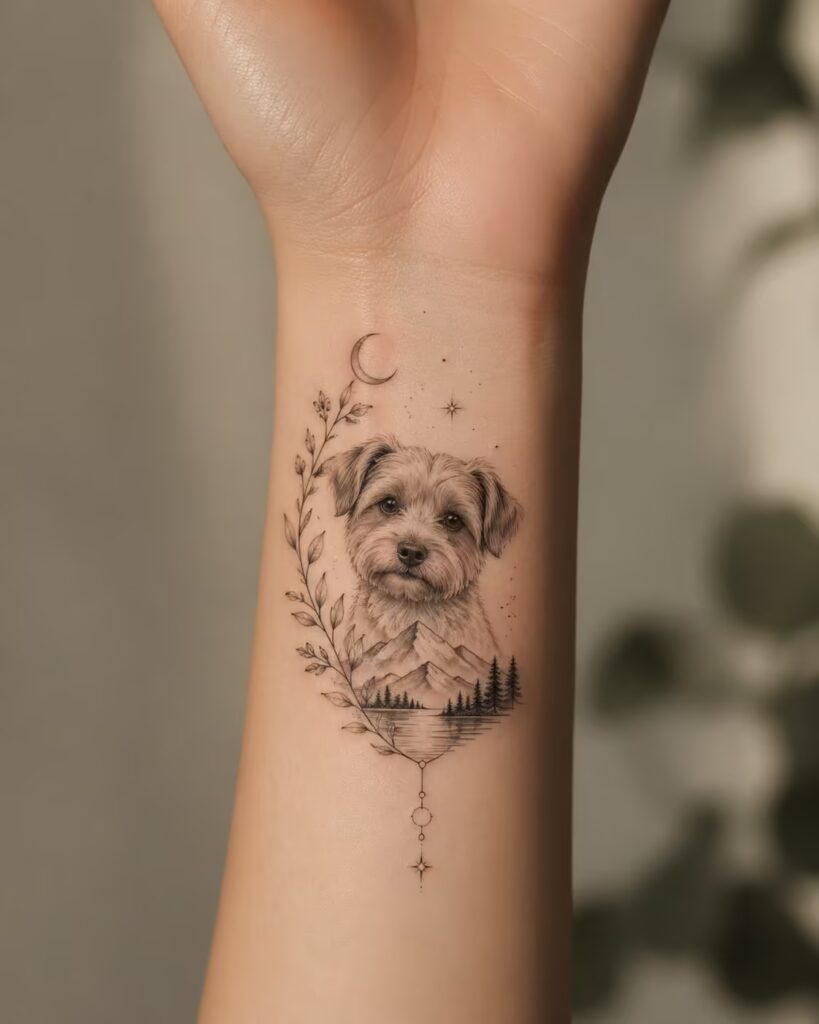
These designs allow the tattoo to tell a story beyond “here is my pet” — they capture something about the relationship, the feeling, the specific texture of missing them.
7. Multiple Pet Memorial Tattoos
For people who have lost more than one beloved animal — or who want to honor multiple pets in one piece — there are several approaches:
- A series of small matching tattoos (one per pet) that build over time into a sleeve or grouping
- A single composition that incorporates multiple animals (requires an artist skilled at complex compositions)
- A shared symbol (like interlinked paw prints, or a shared floral element) rather than individual portraits
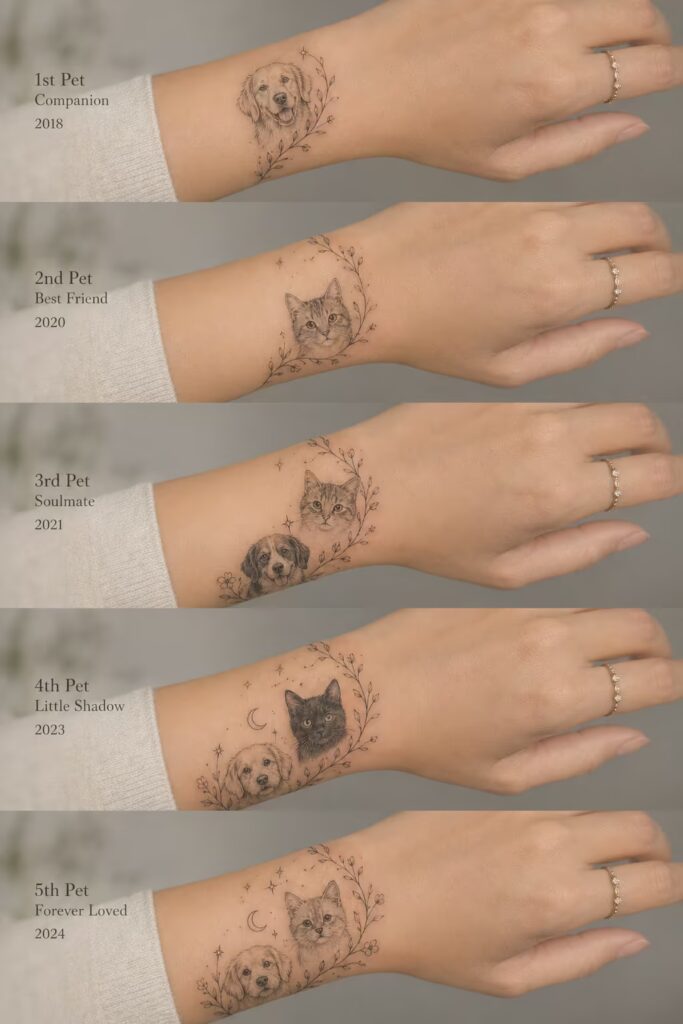
Planning tip: If you think you’ll want to add pets in the future, discuss this with your artist upfront so the placement and scale of the first tattoo allows for expansion.
Pet Memorial Tattoo Placement Guide
Placement affects everything: visibility, size, longevity, and what the tattoo means to you specifically.
Most Popular Placements
Inner forearm: Highly visible to you, easily shown to others, excellent for medium-to-large designs. One of the most commonly chosen spots for memorial tattoos because you can see it throughout the day.
Wrist: Ideal for smaller, simpler designs — a name, a small paw print, a minimalist silhouette. Very personal and visible, though the skin moves a lot, so fine lines need an experienced hand.
Upper arm/shoulder: More surface area, good for detailed portraits or larger compositions. Less visible to you day-to-day, which some people actually prefer — it’s intimate rather than on constant display.
Chest/over the heart: Emotionally significant placement for obvious reasons. Works beautifully for portraits and meaningful symbols. Moderate pain level.
Thigh: One of the best placements for large, detailed work — plenty of surface area, relatively low pain, and ages well. Less visible in daily life.
Ankle/foot: Popular for small paw prints and names. Pain level is higher than in fleshy areas. Fine lines here can spread over time due to skin movement.
Behind-the-ear: For very small, very simple designs only. Intimate, slightly hidden — some people like the feeling that it’s “just for them.”
Ribcage/side: High pain area, but the placement feels meaningful to many — close to the body’s core, intimate. Works well for medium compositions.
A Note on Fading and Longevity
All tattoos fade. But placement affects how fast:
- High-friction areas (hands, feet, inner elbows) fade faster
- Sun exposure accelerates fading — sun protection is not optional on a tattoo you care about
- Skin type affects how ink settles — talk to your artist
How to Find the Right Tattoo Artist
This is, without question, the most important decision you’ll make. The right design in the wrong hands produces a tattoo you’ll regret. The right artist makes even a simple design extraordinary.
Step 1: Define Your Style First
Before you search for artists, decide on your style: realistic portrait, minimalist fine-line, watercolor, traditional, or illustrative. Each style has specialist artists. Searching broadly for “tattoo artist near me” is less useful than searching for “fine line tattoo artist [city]” or “black and grey realism tattoo [city].”
Step 2: Look at Portfolios Critically
Every serious tattoo artist has an Instagram account or website portfolio. Look at it with a specific eye:
- Do they have animal tattoos in their portfolio? Pet portraits specifically?
- Do the faces look like actual animals, or are they generic?
- How do their healed tattoos look? (Ask — many artists share healed photos)
- Is there consistency in quality across their work?
Step 3: Don’t Optimize for Price
Memorial tattoos are permanent. This is not the category to cut corners in. A mediocre tattoo costs the same to get touched up or covered as it cost originally — plus the emotional cost of wearing something that doesn’t honor your pet the way you intended.
Reputable artists charge $150–$350+ per hour. A good portrait tattoo might cost $300–$800+, depending on size and detail. That is not a lot of money for something you’ll wear for the rest of your life.
Step 4: Book a Consultation
Before committing, have a conversation with the artist — in person or via DM/email. A good artist will:
- Ask about your pet and the reference images you have
- Have opinions about placement and size that serve the design, not just what you want to hear
- Be honest about what’s achievable in your preferred style
An artist who just says yes to everything you suggest without pushback is not necessarily your best choice.
Preparing Your Reference Photos
For portrait tattoos, especially, reference photos are everything. Here’s how to give your artist the best possible material:
Ideal reference photos:
- High resolution — the highest quality you have
- Well-lit, preferably in natural light, without harsh shadows across the face
- Multiple angles: straight-on face, slight profile, looking up (the expression you most want to capture)
- Close-ups of specific features: the markings around the eyes, any distinctive coloring, the shape of their nose
If your pet has passed:
- Check your phone’s camera roll going back years — you likely have more photos than you think
- Ask family members for photos they might have taken
- Check old social media posts
If you’re planning ahead while your pet is still alive: Take dedicated reference photos now. Photograph them in good light with a still expression. You don’t need to think about it as “I’m preparing for when they die” — think of it as creating a record of them at their best. You’ll be grateful later either way.
What to Expect From the Tattoo Process
If this is your first tattoo, or your first memorial tattoo, here’s what the process looks like:
Booking: Most reputable artists have waitlists of 2–6 months. Plan accordingly. The wait can actually be useful — it gives you time to be certain about the design.
The day of: Eat a proper meal beforehand. Bring water and a snack. Wear or bring clothing that gives easy access to the placement area.
During the session: The pain level varies enormously by placement — a forearm tattoo is very manageable for most people; a ribcage tattoo is genuinely uncomfortable. Breathe. Don’t tense. It’s okay to ask for breaks.
Emotional aspect: Many people find memorial tattoo sessions unexpectedly emotional. You may cry. That’s completely normal — you’re thinking about your pet in close detail for an extended period of time, often for the first time since the loss. Some artists are excellent at holding space for this; let them know upfront if this is a memorial piece.
Aftercare: Follow your artist’s aftercare instructions exactly. The healing process takes 2–4 weeks for the surface, 3–6 months for the deeper layers to fully settle. Protect from the sun. Keep it moisturized. Don’t pick.
Meaningful Symbols to Incorporate
Beyond the portrait or paw print, certain symbols carry weight in pet memorial tattoos:
| Symbol | Meaning |
|---|---|
| Paw print | Their physical presence, the mark they left |
| Heart | Love, obvious but eternal |
| Wings | Freedom, the idea of them unburdened |
| Stars | Guiding light, looking down |
| Infinity symbol | Love without end |
| Hummingbird | Visitation — the idea that they return to check on you |
| Semicolons | Their story continues in you |
| Wildflowers | Growth from grief, natural beauty |
| Moon | Quiet watching, constancy |
| Date/coordinates | Anchoring them to time and place |
Frequently Asked Questions
How long should I wait before getting a memorial tattoo? There’s no right answer. Some people book an appointment within weeks of losing their pet — the urgency of grief makes action feel necessary and right. Others wait a year or more, wanting to be certain about the design when they’re thinking more clearly. Both are valid. The only useful question is: Am I ready to be still with this decision? If yes, you’re ready.
Can I get a tattoo of a pet who is still alive? Absolutely. Many people choose to do this while they still have the chance to take perfect reference photos and capture their pet at their most vibrant. There’s nothing morbid about it — it’s an act of love, not anticipation of loss.
What if I’m not happy with the tattoo? Speak to your artist first about a touch-up if the issue is technical (fading, lines that didn’t hold). If the design itself is wrong, a skilled cover-up artist can usually work with what’s there. This is why artist selection matters so much upfront — it’s far harder and more expensive to fix than to get right the first time.
Should I get my pet’s actual paw print tattooed? If you have it, yes — it’s one of the most personal choices you can make. If you don’t have it, a skilled artist can create a naturalistic paw print that feels true to your pet’s size and weight. It won’t be their exact print, but it can still be deeply meaningful.
What’s the average cost of a pet memorial tattoo? Small minimalist designs: $80–$200. Medium designs with moderate detail: $200–$500. Detailed realistic portraits: $400–$1,000+. Prices vary significantly by artist experience level, location, and session length.
Does the meaning of the design matter more than the style? Yes and no. The meaning is personal — only you know what a particular symbol meant in the context of your relationship with your pet. But the visual execution of the style affects how you feel about the tattoo every day for the rest of your life. Both matter. Don’t sacrifice one for the other.
A Note on Timing and Grief
If you’re reading this in the raw early weeks of loss — the kind of grief where everything feels wrong and too bright and slightly unreal — there’s no pressure to decide anything right now.
A memorial tattoo will be available to you whenever you’re ready. The right design will still be right six months from now. The right artist will still be there.
Some people find that the process of researching and planning a memorial tattoo is itself a form of grief work — a way of sitting with the love rather than just the loss, of directing the energy of grief toward something creative and lasting. If that’s where you are, this guide is meant to help.
Take your time. Your pet deserves your clearest intention, not your most urgent one.